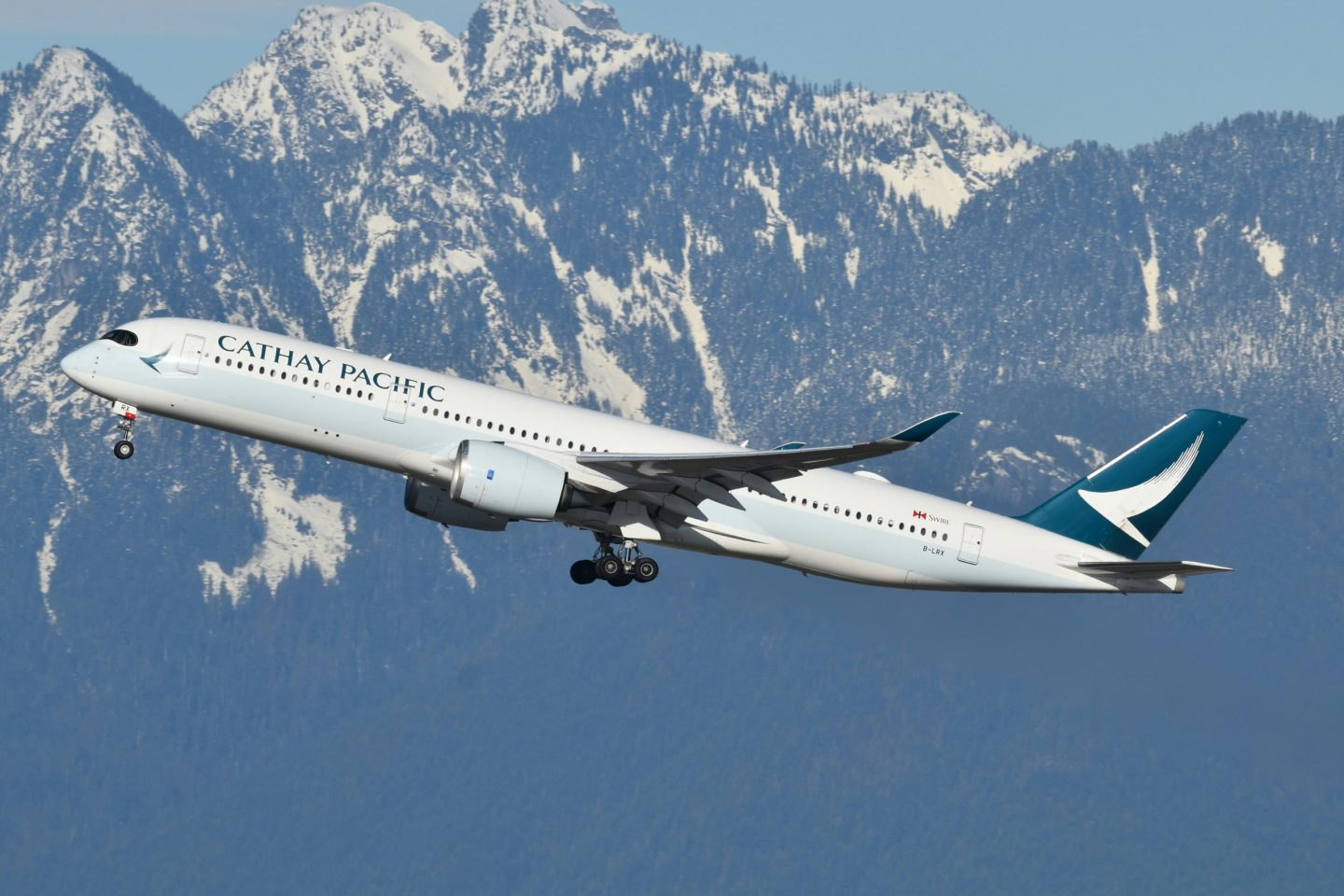
- Cathay Pacific expands Google AI contrail trials after a 40% warming reduction.
- Contrail avoidance can cut warming but raise fuel use by 2%.
Cathay Pacific is expanding a trial with Google that uses artificial intelligence to help pilots avoid atmospheric conditions where heat-trapping aircraft contrails can form.
The second phase will test the technology across Cathay Pacific’s Asian and transpacific routes following an initial operational trial that began in late 2025. The companies are assessing whether contrail avoidance can be incorporated into normal flight operations across different routes and airspaces.
Cathay Pacific is Google’s first commercial airline partner in Asia-Pacific to test its AI-based contrail technology. It is also the first airline to trial contrail avoidance on ultra-long-haul flights, which Google defines as flights lasting more than 16 hours.
Cathay and Google said previous operational contrail research has underrepresented Asia-Pacific, a gap the expanded trial is intended to address.
The trial targets a different part of aviation’s climate impact from efforts to cut carbon dioxide emissions. Because persistent contrails form only under specific atmospheric conditions, they can be targeted through changes to flight paths or altitude.
The European Union Aviation Safety Agency says non-CO₂ effects accounted for more than half of aviation’s estimated net warming from historical emissions between 1940 and 2018. EASA also notes that estimates of non-CO₂ effects carry substantially more uncertainty than estimates for CO₂.
Cathay cites research estimating that persistent contrails account for around one-third of aviation’s total climate impact. The Google trial focuses specifically on reducing that non-CO₂ effect through changes to flight operations.
AI forecasts guide flight changes
Google’s system combines AI-based predictive models with satellite imagery and weather data to identify areas where persistent contrails are more likely to form.
Flight dispatchers and pilots can use these forecasts to plan small altitude adjustments around those areas. Aircraft already make altitude changes during normal operations for factors such as turbulence and weather conditions.
Cathay Pacific delivers Google’s forecasts to pilots through its Electronic Flight Folder, an internally developed system used in the cockpit. In-flight Wi-Fi allows updated contrail forecasts to be presented alongside other operational information during a flight.
A peer-reviewed study involving Google Research and American Airlines used a physics-based model alongside a machine-learning model trained on satellite-detected contrails and numerical weather data to predict where contrails were likely to form.
Contrails form when aircraft pass through cold and humid conditions at high altitude. While many disappear quickly, some remain and spread into cloud-like formations that trap heat in the atmosphere.
Forecasting those conditions remains difficult. The study detected contrails on about half of the control flights predicted to encounter contrail-forming conditions, while the researchers identified uncertainties in weather forecasts and contrail formation as factors affecting operational deployment.
Trial results show benefits and fuel trade-offs
The initial Cathay Pacific trial targeted more than 100 flights across the airline’s network. More than 80 flights followed routes that incorporated contrail-avoidance measures.
Not every targeted flight was able to use an avoidance route. Cathay said airspace and aircraft payload restrictions prevented some flights from participating.
Google analysed satellite imagery from the participating flights and estimated that those following contrail-avoidance routes reduced contrail-related warming by roughly 40%. The figure applies specifically to estimated contrail warming, not the flights’ CO₂ emissions or total climate impact.
The Hong Kong-Singapore corridor was among the routes included in the trial because flights in the area frequently encounter conditions associated with persistent contrail formation.
Cathay said early analysis found that small altitude adjustments were able to prevent some contrails from forming. Google said interventions on the Hong Kong-Singapore route accounted for more than 50% of the reductions recorded during the trial.
Altitude changes can increase fuel consumption when an avoidance route moves an aircraft away from its most fuel-efficient trajectory. This creates a trade-off between reducing contrail-related warming and producing additional CO₂ from higher fuel use.
A peer-reviewed study published in Communications Engineering in 2024 examined that trade-off using flights operated by American Airlines with contrail predictions developed by Google Research and Breakthrough Energy. The flights that attempted contrail avoidance showed a 54.4% reduction in detectable contrail distance per kilometre flown compared with the control group.
The adjusted flights used an average of 2% more fuel, equivalent to an additional 0.26 kilograms of CO₂ per kilometre flown by the treatment group. The researchers identified fuel use as one of the operational factors that needs to be considered when contrail avoidance is applied to commercial flights.
A separate Nature Communications study published in January this year examined the wider climate trade-off using modelling rather than operational data from Cathay. It noted that existing research generally expects a fleet-wide fuel penalty of less than 2% from contrail avoidance.
The study estimated that, over practical timescales within this century, warming caused by the additional CO₂ emitted during contrail avoidance would be around two orders of magnitude lower than the expected reduction in contrail warming. The finding does not measure the fuel or climate impact of Cathay Pacific’s current trial.
Google’s work with Cathay follows earlier testing with American Airlines. In 2023, Google reported a 54% reduction in detected contrails during a 70-flight trial, while a later trial integrated its forecasts into flight-planning software used across 2,400 scheduled transatlantic flights. Google said flights that successfully followed the avoidance plans recorded a 62% lower contrail-formation rate than the control group.
Cathay expands testing across APAC
The Cathay trial extends testing to Asian and transpacific routes, including ultra-long-haul flights, while delivering updated contrail forecasts directly to pilots through cockpit systems.
Cathay and Google said the larger trial is intended to generate a broader set of real-world operational data from the region.
The second phase will involve a larger set of trial flights across Asian and transpacific routes. Contrails.org, a nonprofit initiative focused on contrail mitigation research, is also participating in the project.
Cathay Pacific and Google said the expanded trial will examine how contrail avoidance performs across different routes and airspaces, as well as the operational constraints involved in using avoidance measures on commercial flights.

Want to learn more about AI and big data from industry leaders? Check out AI & Big Data Expo taking place in Amsterdam, California, and London. The comprehensive event is part of TechEx and is co-located with other leading technology events, click here for more information.
Tech Wire Asia is powered by TechForge Media. Explore other upcoming enterprise technology events and webinars here.