- A GlobalFoundries hub in Penang supports all of the company’s wafer fabs in Singapore, Germany and the United States.
- GF says it could not find enough engineers in Singapore, and the Malaysian ones would rather not leave home.
GlobalFoundries runs a hub in Penang whose engineers can see inside, and intervene in, every wafer fab the company operates, according to Tan Yew Kong, senior vice president and general manager of GF’s Asia-Pacific manufacturing and its Singapore site.
“That place actually controls my machine,” Tan said. “They can actually stop the machine from running.”
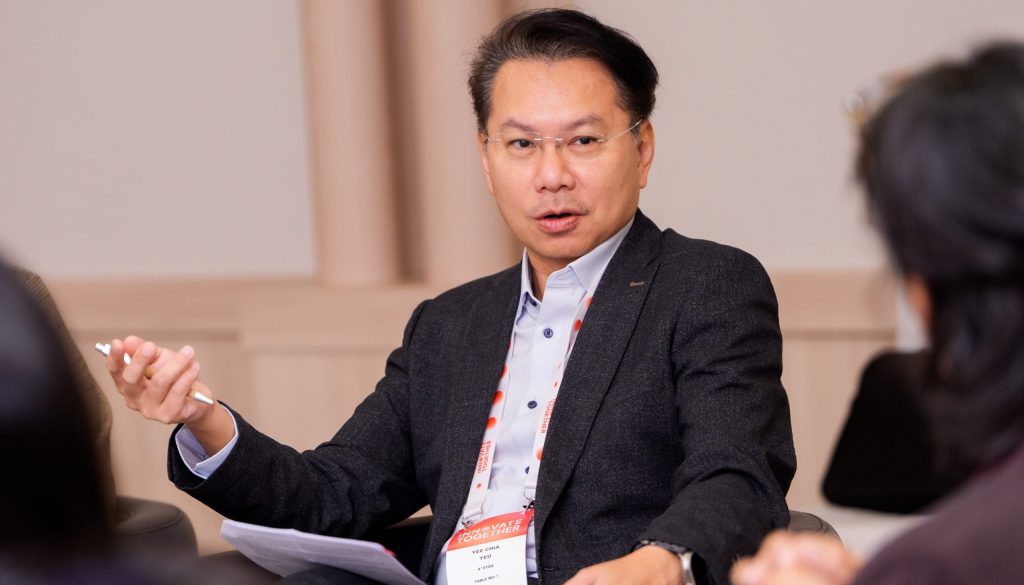
He spoke in a group interview with Tech Wire Asia and another publication at Innovate Together 2026, A*STAR’s annual semiconductor forum, held at Resorts World Convention Centre in Singapore on 25 September. GF was among the companies that announced new collaborations with A*STAR at the event, in its case on silicon photonics.
The Penang hub is part of a programme GF calls Global Fab Engineering Services. The company launched it in Bengaluru in 2015, focused on process integration and yield analytics, then opened the Penang site in 2023, expanding the work into manufacturing operations and process engineering, according to a GF blog post published in May. Engineers at the hubs qualify tools, classify defects, monitor statistical process controls and make wafer decisions remotely, GF said, while manufacturing itself stays in the fab.
Those fabs sit in three countries. GF’s 300mm Fab 8 is in Malta, New York, and its 200mm Fab 9 is in Essex Junction, Vermont. Fab 1 is in Dresden. Fabs 2, 3, 5 and 7 are at Woodlands in Singapore. Penang, Tan said, supports all of them.
GF’s published account of the model is more measured than Tan’s. “The practical reality is less dramatic than the concept sounds, which is kind of the point,” the company wrote.
The hub runs on a platform GF calls the FCT, which lets engineers at one site pull up a live view of any other site. Tan illustrated it by casting the journalists around the table as GF’s sites, with himself in Malaysia. If a colleague in Singapore wants his attention, he said, they can ask him to switch to their channel. “I actually can call up what Singapore is seeing. I can see the same.”
The system also ranks equipment by how badly it is holding up production. “You can see the one in red, the very red and the not so red,” Tan said. “The one is very red; you feel so bad, because that is the one that is the most guilty of the whole wafer flow.” He said it covers more than a thousand machines, and flags material likely to run into problems over the next 12 hours so the incoming shift can act before the day starts.
Tan was specific that the work is not assembly or test. “They are using their digital capability to help us do engineering work as well as process optimisation as well as manufacturing capabilities,” he said, adding that the hub also helps standardise procedures across GF’s factories globally.
He was equally specific that nothing was moved out of Singapore. “We did not take away the manpower in Singapore to put into that,” Tan said, because the fab still needs people on the floor for physical maintenance.
GF could not move the semiconductor talent, so it moved the work
Asked directly why the hub is not in Singapore, Tan gave one reason.
“I cannot find enough people in Singapore. That’s my first problem,” he said. “Same thing in Dresden. Same thing in the US. Talent availability is a big headache.”
The second reason is that the engineers he wanted were not willing to relocate.
“Today Malaysia has quite a bit of semicon talent,” Tan said. “But they may not want to leave their hometown. So having that, at least we are reaching out now rather than forcing them to come to us.” He added that Malaysian engineers offered work at home “would love to take up the job because they don’t have to leave their families.”
Tan said the arrangement also means the Singapore site does not have to hire in proportion when GF expands capacity there, because part of the additional work sits in Penang.
The time difference is the other argument for putting the work offshore, though in Penang’s case there is none. “Can you imagine you go back home, tomorrow you come back, the world is still functioning,” Tan said. GF makes the same point about its India hub, writing that “a question raised in Singapore at the end of the day has someone looking at it in India before the night is out.”
GF Singapore employs more than 4,300 people across 22 nationalities and produces 1.25 million wafers a year in 300mm-equivalent terms, according to a company fact sheet, across a 200mm fab and a 300mm fab at Woodlands.

The generation that had to move
Sixteen years ago, the option Tan describes did not exist.
Loges Kumar Mogannathas grew up on mainland Penang, took a chemical engineering degree at Universiti Teknologi Malaysia and spent his first five years at SilTerra in Kulim Hi-Tech Park. Then Singapore came recruiting.
“A hiring agent came from Singapore to Malaysia back then, in 2008,” Loges told reporters in a separate interview session the same day. “It was STMicroelectronics from Singapore. They came to Penang Island and held a massive interview. So I attended, and I got a job.”
He moved in 2010, spent seven years at STMicroelectronics and five more in industry before joining A*STAR’s Institute of Microelectronics, where he is a senior research engineer. He has been a Singapore permanent resident since around 2014.
Loges was also clear about where his foundation came from. “In Malaysia, we do have a lot of good mentors in semiconductor,” he said. “If you are really lucky with good mentors, you will become a good [engineer]. I was blessed to have these mentors in my life.”
Asked what draws engineers to one country over another, he did not lead with pay. Access to equipment mattered more. “If, let’s say I have the machines that I wanted and it’s available somewhere, I can then do a lot of research there,” he said. “Compared to if I don’t have access, I need to send the wafers or samples to an outside country and wait for three days, four days.”
Singapore’s R&D, Malaysia’s back end, and why Yeo rejects that
Both governments’ framing of the relationship came up repeatedly during the visit. Professor Yeo Yee Chia, deputy chief executive for innovation and enterprise at A*STAR and executive vice president of Singapore’s RIE2030 Flagship in Semiconductors, pushed back when a journalist put the conventional version to him, that Singapore holds the R&D and Malaysia the low-cost back end.

“That’s what you said. I didn’t say that,” Yeo replied. He described the two countries as “quite integrated,” said differing land and electricity costs shape how companies split operations across the border, and added: “Malaysia moving up the value chain is a good thing. It’s wonderful, because Singapore is also moving up the value chain. So let’s move up together.”
On talent, Yeo said the shortage in Singapore is “quite acute,” and agreed it is acute in Malaysia too.
GF’s own appetite for going further into Malaysia is more measured. Asked about collaboration with Malaysian partners in advanced packaging and silicon photonics, Tan said the company’s focus is currently on working with A*STAR and its Singapore plant, and that suppliers elsewhere would be considered on availability and suitability. “You can’t engage so many people, because it takes time, effort,” he said.
“For our presence in Malaysia today, we are very impressed with the engineering,” Tan said.
Editor’s note: This article was updated on 6 October 2026. A paragraph describing a change in A*STAR’s hiring policy has been removed. A*STAR has said the information was inaccurate.