- Huawei advances Ascend 960 and its 11-chip AI portfolio.
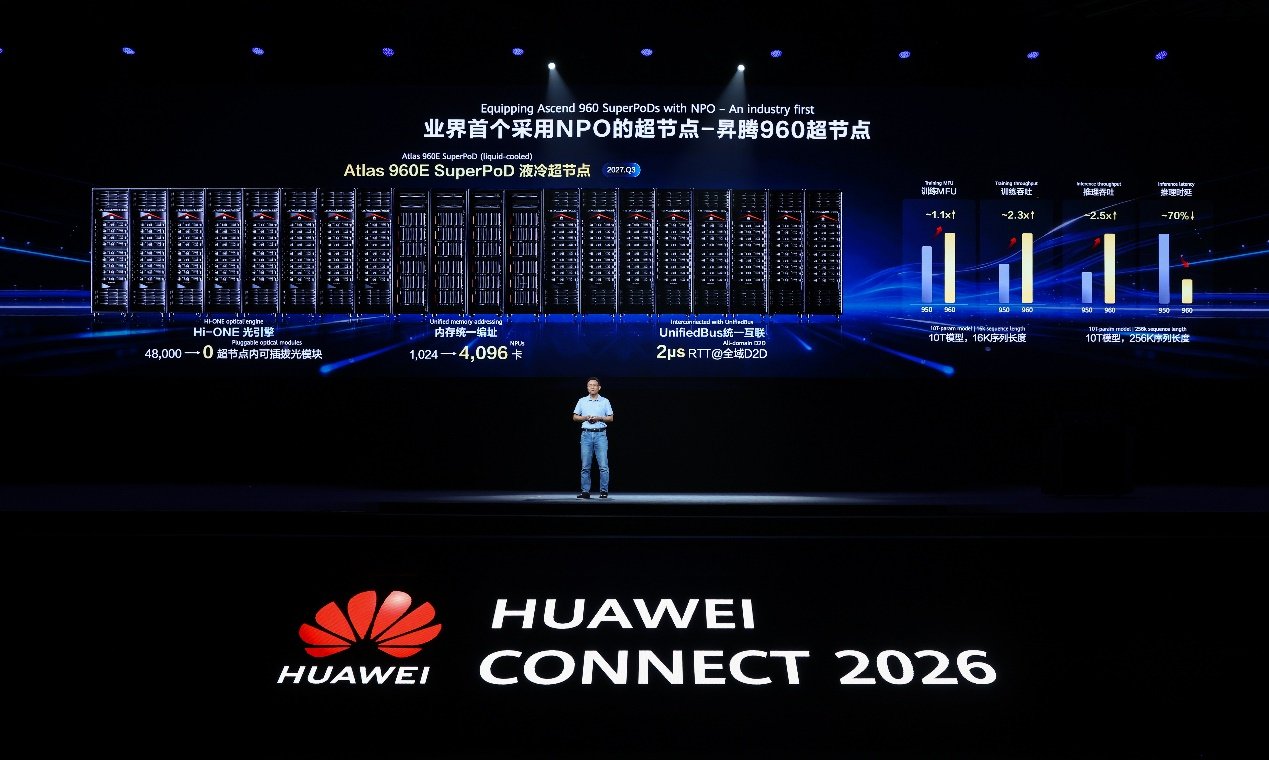
- Atlas 960E combines Ascend 960 with near-packaged optics.
Huawei has outlined an accelerated roadmap for its Ascend AI chips alongside new infrastructure designed to connect thousands of processors into larger computing systems.
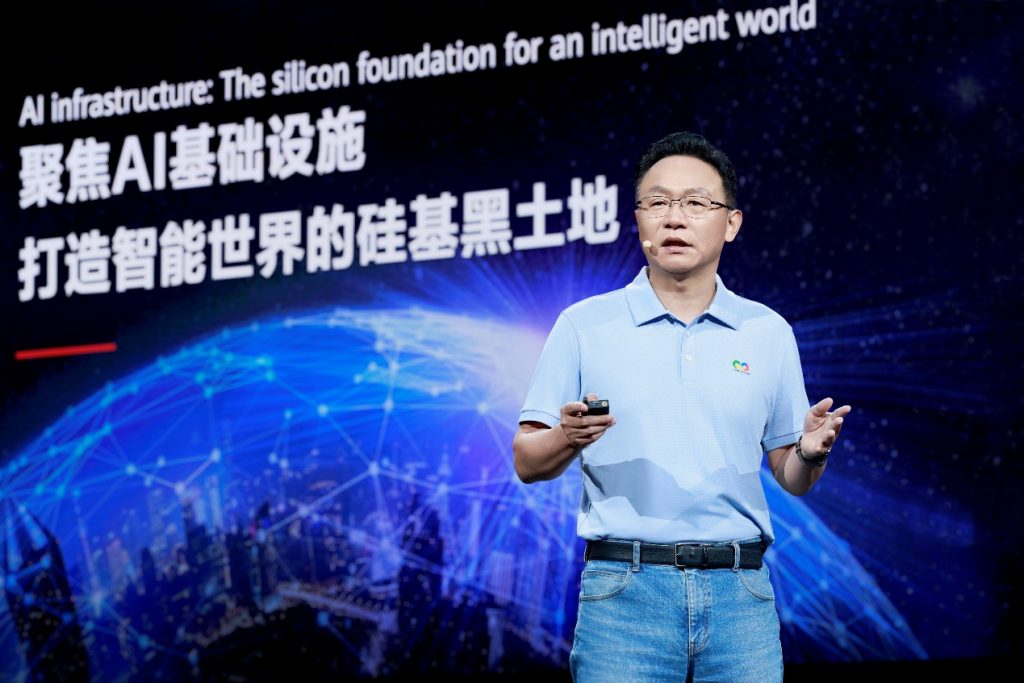
David Wang, Huawei’s deputy chairman and rotating chairman, detailed the plans during a keynote at HUAWEI CONNECT 2026 in Shanghai. The announcements centred on the Ascend 960 roadmap and new SuperPoD and SuperCluster infrastructure.
Ascend 960 and 11-chip portfolio
Huawei said the Ascend 960 is progressing ahead of its original schedule. The Ascend 960DT is now expected in the first quarter of 2027, three quarters earlier than previously planned, while the Ascend 960PR is scheduled for the third quarter of 2027.
The company also plans to release the Ascend 970 in 2028 and the Ascend 980 in 2029. “We’re evolving our Ascend chip series on a one-generation-a-year cycle,” Wang said.
Wang said future generations would also target higher memory bandwidth, memory capacity, and interconnect bandwidth alongside increases in compute performance.
The Ascend series forms part of a broader 11-chip portfolio Huawei has developed for its SuperPoD and SuperCluster systems. Built around the company’s UnifiedBus architecture, the portfolio covers computing, interconnect, storage, and management functions.
Huawei has not identified all 11 chips individually in the announcement, but described Ascend as the main computing component of the portfolio. UnifiedBus is used to connect the different parts of the system through a common interconnect architecture.
Similar system-level designs are appearing elsewhere in the AI infrastructure market. NVIDIA’s Vera Rubin NVL72 combines Rubin GPUs, Vera CPUs, NVLink switches, ConnectX-9 SuperNICs, and BlueField-4 data processing units, while AMD’s Helios architecture combines Instinct GPUs, EPYC CPUs, Pensando networking, and ROCm software.
The architectures differ, but each brings compute, networking, and other infrastructure components together as part of a wider system design.
Reuters reported that Huawei is using this system-level approach to offset limitations at the individual-chip level, connecting large numbers of processors with memory, storage, and networking infrastructure so they can operate as larger computing systems.
Atlas 960E and optical interconnects
Huawei is also extending its SuperPoD architecture, which connects multiple computing nodes through high-speed interconnects and presents them as a single logical computing system. Huawei reported that more than 1,000 Atlas 900 A3 SuperPoDs have been deployed, while the Atlas 950 has entered commercial use.
According to Huawei, larger AI clusters face communication overhead as data moves between processors during model training. According to the company, simulations conducted by its Markov Lab found that a 100,000-NPU cluster built with 4,000-NPU SuperPoDs could deliver a 2.75x increase in model FLOPs utilisation compared with a cluster composed of eight-NPU servers.
AMD has similarly identified bandwidth and latency as constraints when AI workloads are distributed across large numbers of GPUs, particularly when training requires frequent synchronisation between processors.
Within its wider infrastructure roadmap, Huawei also introduced the Atlas 960E SuperPoD, which combines Ascend 960 processors with its Hi-ONE optical interconnect technology. Huawei describes the Atlas 960E as the industry’s first NPO-based SuperPoD.
According to Huawei, a single Atlas 960E can scale to 4,096 NPUs and provide 8 EFLOPS of FP8 compute performance with up to 1 petabyte of high-bandwidth memory.
Hi-ONE uses NPO, which places optical components closer to the computing or switching silicon, shortening the high-speed electrical path between them. Huawei lists transmission capacity of 7.2 Tbit/s for each Hi-ONE engine.
The IEEE Solid-State Circuits Society identifies near-packaged and co-packaged optics as approaches being developed to increase bandwidth density and energy efficiency as AI systems place greater demands on data movement. Research published in IEEE Communications Magazine has also pointed to power, latency, and density constraints in conventional pluggable optics.
“We have developed a next-generation optical interconnect product based on near-packaged optics,” Wang said, referring to Hi-ONE. Huawei says the technology, combined with UnifiedBus, is intended to make it easier to scale SuperPoD interconnect systems.
Huawei describes Hi-ONE as the industry’s first NPO product ready for mass production and the first with an integrated light source.
Huawei estimates that an Atlas 960E uses about 5,500 Hi-ONE units instead of the roughly 48,000 800G optical modules that would otherwise be required to connect its NPUs. The company estimates that this design reduces power consumption by more than 550 kilowatts and provides 99.8% system availability.
The company has submitted an implementation agreement covering NPO technology to the Optical Internetworking Forum, an industry standards organisation. Huawei said it plans to continue developing the technology with industry partners.
Huawei is also updating its general-purpose computing infrastructure through the TaiShan 950 SuperPoD. The system uses UnifiedBus optical networking and supports up to 4,096 nodes with a unified memory pool of as much as 256 TB.
Huawei reported several workload benchmarks for the TaiShan 950. According to the company, the system can start 100,000 software sandboxes 30 times faster than traditional servers, increase sandbox density by 25%, and provide twice the search efficiency when processing 10 billion vectors with 1,000 dimensions.
Huawei also introduced the OceanStor M900, a storage cluster intended to provide multi-tier key-value caching for AI inference workloads. The system uses UnifiedBus to provide direct access to a petabyte-scale KV cache and combines different storage media with a retention algorithm that Huawei says extends SSD read-and-write lifespan 16-fold.
The TaiShan, Ascend, and storage systems form part of what Huawei calls its agentic SuperCluster architecture. UnifiedBus is used to connect Ascend SuperPoDs, Kunpeng-based SuperPoDs, and KV cache storage while reducing the need for protocol conversion between systems.
According to Huawei, the architecture uses a two-tier, four-plane Clos network and can interconnect as many as 512,000 NPUs. A multi-rail topology is designed to extend the configuration to one million NPUs, according to the company.
The one-million-NPU figure refers to the stated scaling capacity of the architecture rather than a deployed million-processor cluster. Reuters reported that Huawei’s new Ascend 960-based system is designed to connect up to 4,096 AI processors, with multiple systems then linked into clusters containing hundreds of thousands of processors.
Open-source software and ecosystem
Alongside its hardware roadmap, Huawei provided updates on its software ecosystem. Huawei reported that more than 40 AI models have been natively pre-trained using Ascend hardware and its Compute Architecture for Neural Networks, or CANN.
According to Huawei, external developers now account for 61% of all CANN developers, while the community has more than 5,200 monthly active developers. Ascend currently supports more than 90 third-party open-source projects, including PyTorch, Triton, vLLM, and veRL.
Jim Zemlin, CEO of the Linux Foundation, also addressed the role of open-source software in AI infrastructure during a keynote at HUAWEI CONNECT 2026. “At every single layer of the agentic AI stack, there is an open-source project powering that technology,” Zemlin said.
He cited Linux and Kubernetes at the infrastructure layer, PyTorch for model training, and vLLM and Ray for inference. Zemlin also pointed to emerging open-source protocols such as MCP and A2A at the agent layer.
Huawei joined the PyTorch Foundation as a Premier Member in 2023, when the foundation said the company would continue work to optimise PyTorch for its Ascend computing platform. Huawei also participated in PyTorch Conference China in Shanghai in September 2026, where sessions covered distributed training, inference, hardware integration, cloud infrastructure, and agents.
The PyTorch Foundation’s wider project ecosystem now spans model training, inference, orchestration, and deployment, including projects such as PyTorch, vLLM, DeepSpeed, and Ray.
Huawei reported that its wider Kunpeng ecosystem has more than 4.16 million developers and over 7,200 partners. The company also reported more than 20 million openEuler installations.

Want to learn more about AI and big data from industry leaders? Check out AI & Big Data Expo taking place in Amsterdam, California, and London. The comprehensive event is part of TechEx and is co-located with other leading technology events, click here for more information.
Tech Wire Asia is powered by TechForge Media. Explore other upcoming enterprise technology events and webinars here.