
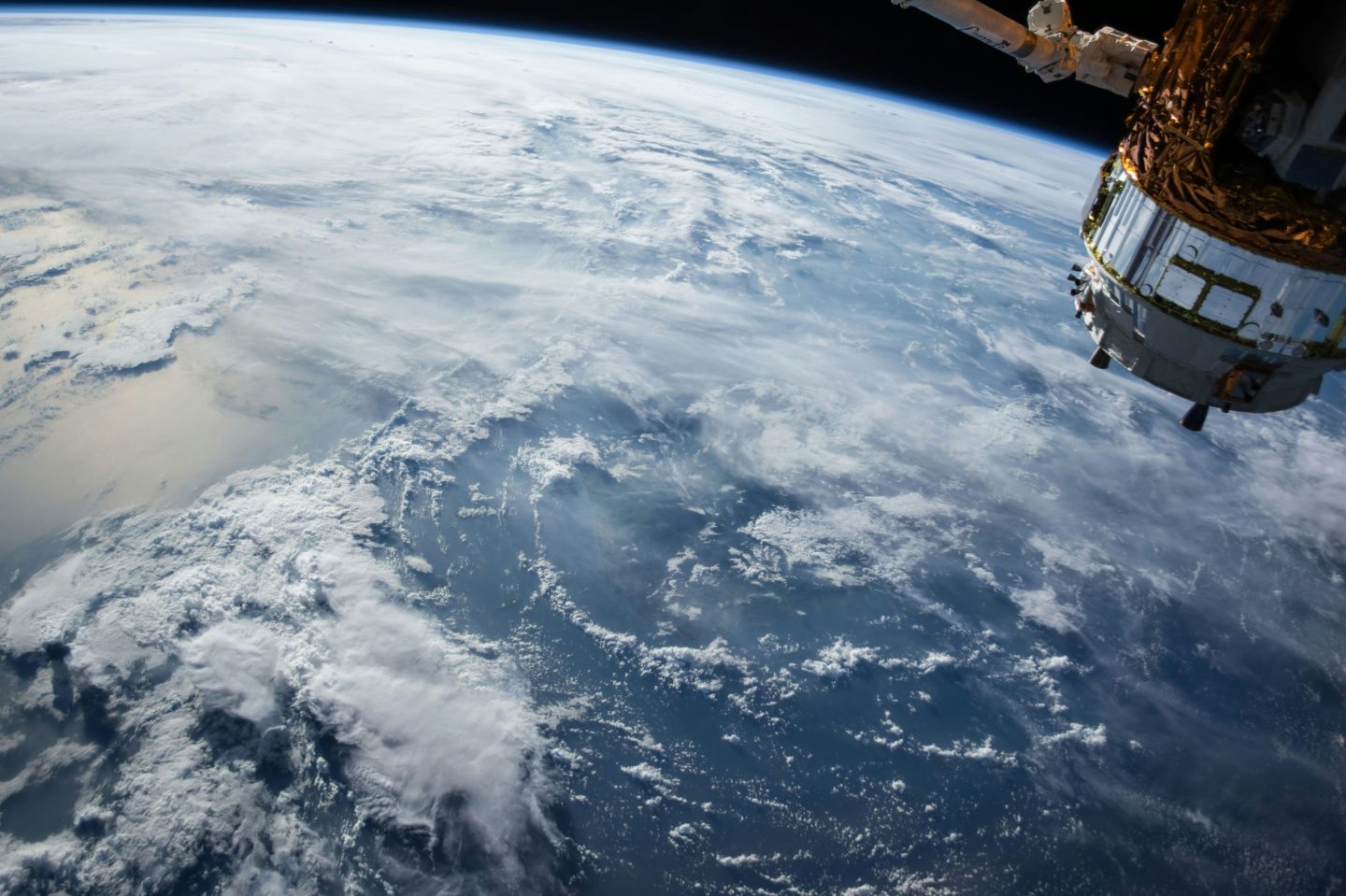
- Google launched four TPUs to test AI chips in space.
- Project Suncatcher tests orbital AI despite technical and cost hurdles.
Google has placed four TPUs into low Earth orbit as part of Project Suncatcher, an experiment examining whether AI computing infrastructure can operate in space.
The prototype satellite launched on October 1 aboard SpaceX’s Transporter-18 rideshare mission and carries four Trillium-generation TPUs. Google said it had established contact with the satellite and that it was operating as expected.
Google announced Project Suncatcher in 2025 to study the technical requirements for running machine learning infrastructure on interconnected satellites.
The project comes as data-centre electricity demand increases. The International Energy Agency (IEA) expects global data-centre electricity use to rise from about 485 terawatt-hours (TWh) in 2025 to around 950 TWh by 2030, while electricity consumption from AI-focused facilities is projected to triple over the same period.
The IEA has also identified grid connections, transformers, energy equipment, advanced chips, and other infrastructure as constraints on new data-centre projects. It estimates that data centres can become operational within two to three years, while the energy infrastructure needed to support them often requires longer planning and construction periods.
Project Suncatcher examines an alternative infrastructure model based on solar-powered computing in orbit.
The project is testing whether AI processors can withstand launch forces and radiation, whether their heat can be removed in a vacuum, and whether future groups of satellites can exchange enough data to operate as a larger computing system.
Testing AI hardware in space
TPUs are custom processors used by Google to train and run AI models. Unlike processors designed specifically for spacecraft, the chips aboard the Project Suncatcher prototype are based on AI hardware also used for terrestrial computing workloads.
The hardware will be tested over the coming weeks to determine how the processors perform under launch stresses, radiation exposure, and orbital thermal conditions. Google said the experiment is intended to collect data that cannot be fully reproduced through ground-based testing.
Before launch, Google subjected the hardware to vibration testing intended to reproduce the forces experienced during a rocket flight. The company said the journey to low Earth orbit involves sustained acceleration of up to 10 times the force of gravity, while individual components such as TPU chips can experience forces of 50 to 100 g.
Radiation presents another constraint because high-energy particles can disrupt or damage electronics. Google tested its Trillium TPUs at the Crocker Nuclear Laboratory at the University of California, Davis, using a proton beam while the processors were running AI workloads.
The tests monitored errors such as bit flips and found that the processors survived a total ionising radiation dose greater than what Google expects them to receive during a five-year space mission. Google has also published peer-reviewed research in the journal Joule describing the work behind Project Suncatcher.
Thermal management presents a separate engineering challenge. AI accelerators produce concentrated heat, while conventional air-based cooling cannot operate in the vacuum of space.
Google has developed a system using heat pipes to move heat away from its processors and radiators to release that heat into space. The company previously tested the design inside a thermal vacuum chamber before placing it on the satellite.
The current prototype is not designed to operate its TPUs continuously. Ars Technica reported that its cooling system supports roughly 15 minutes of processor operation before the TPUs have to shut down while the radiators dissipate accumulated heat.
Future Project Suncatcher designs are expected to carry dozens of TPU chips on individual satellites, increasing the cooling capacity required as processor numbers and power consumption rise.
Power and connectivity
Google estimates that satellites in suitable low Earth orbits can generate up to eight times more solar power than comparable installations on the ground.
This differs from terrestrial data centres, which depend on local grids or on-site generation. The IEA says grid connection queues and shortages of energy equipment are already constraining the expansion of some data-centre projects.
The agency projects that data centres will account for almost half of US electricity-demand growth through 2030. It also expects data-centre electricity consumption in Southeast Asia to more than double by 2030, partly because of capacity around Singapore and southern Malaysia.
Scaling Project Suncatcher beyond the current prototype would require multiple satellites to operate as a connected computing system. Future satellites are expected to carry dozens of TPUs and communicate through high-bandwidth optical links while remaining in close formation.
That requires the satellites to maintain precise optical alignment as they move through orbit while providing enough bandwidth for distributed computing workloads. Google plans additional missions involving interconnected satellites as it develops this part of the system.
Independent research into orbital data centres also identifies sustained space-to-ground communications as a requirement, alongside utilisation, spacecraft mass, hardware lifetime, and launch cost.
Launch and replacement costs
Putting computing hardware into orbit adds costs that terrestrial data centres do not face.
The Wall Street Journal reported that one model examined for Project Suncatcher estimated that an orbital system providing about 1 GW of computing capacity could require around 10,000 satellites and cost approximately $30 billion to build and launch.
A 2026 technical paper by Jet Propulsion Laboratory physicist Slava Turyshev modelled a 1 MW orbital data-centre configuration and estimated that combined spacecraft and launch costs would need to fall to roughly $250 to $1,000 per kilogram under its assumptions, before communications, operations, utilisation, and hardware-lifetime costs were included.
The paper found that this range remained below the public benchmark price for a dedicated Falcon 9 launch to low Earth orbit even before spacecraft manufacturing costs were added. The model examines orbital data centres broadly rather than Project Suncatcher specifically.
Orbital computing also changes how processors are maintained and replaced. Ground-based data-centre operators can physically access servers and install new computing hardware, while orbital platforms require replacement equipment to be launched or serviced in space.
Turyshev’s technical work identifies finite mission life and hardware replacement cadence as factors affecting the useful computing capacity an orbital system can provide over time.
The current Project Suncatcher mission remains much smaller than the systems described in Google’s longer-term research. Its four TPUs are intended to test how existing AI hardware and thermal systems perform under orbital conditions, providing in-orbit data for the company’s research into scalable machine learning infrastructure in space.

Want to learn more about AI and big data from industry leaders? Check out AI & Big Data Expo taking place in Amsterdam, California, and London. The comprehensive event is part of TechEx and is co-located with other leading technology events, click here for more information.
Tech Wire Asia is powered by TechForge Media. Explore other upcoming enterprise technology events and webinars here.


