- Enterprise AI should be measured by better decisions, not just savings.
- Governance, trusted data, and human oversight are key to scaling AI.
Artificial intelligence has spent the past few years being measured largely in terms of speed: how many hours it can save, how much work it can automate, and how much it can reduce operating costs.
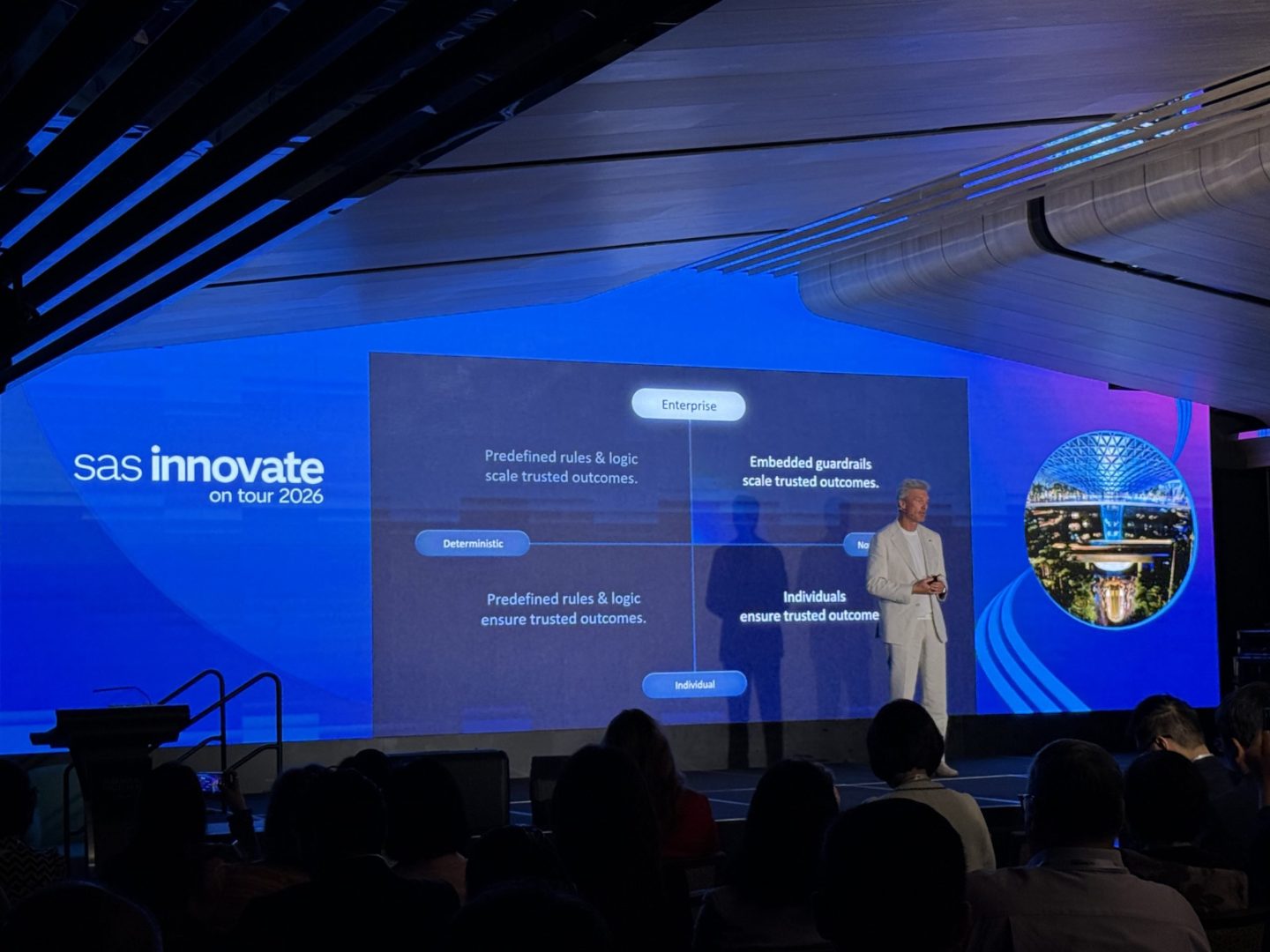
At SAS Innovate 2026, Patrick Xhonneux, Senior Vice President of Marketing at SAS, argued that the bigger question is whether AI can help people make better decisions.
In an exclusive interview with Tech Wire Asia following his keynote, Xhonneux said that shift will require companies to rethink not only how they measure AI, but also how they govern it and decide when humans should remain involved.
“It’s not just about going faster or increasing productivity. It’s about making better decisions,” Xhonneux said. “If you don’t make better decisions, why would you use AI?”
Traditional AI measures have focused on hours saved through automation or lower costs. Xhonneux said companies should also measure whether AI helps employees make better and faster decisions, and whether those decisions can be made safely across an organisation.
Trust changes at enterprise scale
An employee using generative AI to search for information, brainstorm ideas, or write code can review an answer before deciding whether to use it. In that setting, Xhonneux said the individual remains responsible for checking the output and correcting errors.
That model becomes harder to apply when AI is embedded in enterprise processes such as lending, fraud detection, health care, or manufacturing, where one model’s output can influence another system or trigger an action.

“When you move to an enterprise use case, it becomes more about whether we can create a process that delivers repeatability and accuracy consistently,” he said.
During his keynote, Xhonneux compared deterministic and nondeterministic systems. Traditional automated processes generally follow predefined rules, meaning the same input should produce the same result. AI systems built around large language models can behave differently because their outputs are probabilistic.
As more models and agents are connected in the same workflow, errors can also carry through the process. Xhonneux said that creates a need for guardrails to maintain accuracy and reduce the risk of errors compounding across the workflow.
There is also a risk that workers become too dependent on AI recommendations. “Yes, there is,” Xhonneux said. “But if I can map all the different AI models I have, understand who owns what, what kind of data is being used, and so on, then, as a business leader, I can feel more confident that my staff are relying on AI models that have been tested and whose outcomes have been proven.”
Xhonneux said this is also why governance cannot be treated as a layer added after an AI system has already been developed. “You don’t add governance afterwards,” he said. Companies instead need to establish how an AI system will be managed before attempting to scale it. That includes understanding which models are in use, who owns them, what data they depend on, and where bias or other risks could enter the process. The issue becomes more complicated when multiple teams contribute to the same AI-driven decision.
Consider an automated loan decision. Poor-quality or biased data could raise questions about the team managing the data. A problem with the predictive model could fall under an analytics team, while the business unit using that model may be responsible for the final interaction with the customer.
Responsibility can therefore sit across several parts of the organisation, depending on where a failure occurs.
But Xhonneux said senior business leaders remain ultimately accountable. “If somebody makes a mistake while using AI to contact our customers as part of a campaign, ultimately, I’m the one who is accountable,” he said.
Companies therefore, need to define responsibility across data, models, processes, and business outcomes before giving AI systems greater autonomy.
Testing AI decisions with digital twins
Digital twins could also give businesses a way to test some decisions before applying them to real-world operations.
Xhonneux sees this as one area where the technology could become increasingly useful as companies combine it with AI.
Digital twins create virtual representations of physical systems or processes. They can be combined with AI, computer vision, synthetic data, and optimisation to test different scenarios without making immediate changes in the real world.
“What we want people to understand is that, with digital twins, you now have the ability to combine these optimisation techniques to ask some of your most complex ‘what-if’ questions in a safe environment,” Xhonneux said.
During his keynote, Xhonneux pointed to Georgia-Pacific as one example. The paper and tissue manufacturer has used a digital twin to examine activity inside a large manufacturing facility where autonomous guided vehicles move materials around the plant. One question was whether adding more vehicles would increase output. The simulation showed that additional vehicles could instead create congestion. Testing that scenario digitally allowed the company to examine the impact before making a change that could disrupt the physical operation.
Health care provides another example. In both his keynote and subsequent interview, Xhonneux discussed Sterilcentral in Denmark, which handles the cleaning and sterilisation of surgical instruments used by hospitals. Its operations involve large numbers of instruments moving through cleaning, drying, packaging, and distribution processes.
A digital twin allowed the organisation to examine where bottlenecks occurred throughout that workflow. The organisation also used synthetic data and computer vision to model whether workers were wearing protective equipment correctly, as mistakes could increase the risk of contaminating surgical instruments.
“That’s where, for me, the combination of agentic AI or other optimisation tools within digital twins can give you useful information and help you make the right decisions without exposing your operations to high costs or high risks,” he said.
Xhonneux said the main challenge is making sure the digital model reflects the real operation closely enough to be useful. “You always need to start with the reality of the business,” he said. “What are you trying to solve? What is your business need?”
Companies first need sufficient information about the physical process they want to model. Depending on the use case, that may require sensors and other systems capable of capturing what is happening inside a facility. “If you don’t have the technology that allows you to model and visualise reality accurately, it’s not really a digital twin. It’s just another visualisation,” he said.
Data volumes and use-case selection are other constraints. Xhonneux said companies still need to determine which problems are worth modelling and where a digital twin can produce a useful operational result.
Some applications remain experimental. During the interview, Xhonneux pointed to insurance as one area where digital twins could eventually be used to simulate rare events, including climate-related disasters, and examine how they might affect risk and premiums. “Many businesses are now coming to us and asking: Could we use a digital twin for this? Could we use it for that?” he said. “That’s the phase we’re in right now. The market is moving quickly.”
Moving AI beyond pilots
Despite rapid investment and continued attention around generative AI and agentic AI, Xhonneux cautioned against assuming that enterprise adoption is already mature. “A lot of people and companies talk about it, but I haven’t seen massive numbers of use cases that have been highly successful yet,” he said.
Many organisations remain in pilot stages because governance is incomplete, employees still need training, or businesses have not determined how humans and AI should work together.
Xhonneux identified three areas companies need to address: trust in data, governed AI, and human-AI collaboration. “Trust, governed AI, and human-AI collaboration. To me, those are the three areas companies need to invest in today if they want to successfully use AI to serve their customers,” he said.
Xhonneux said companies cannot focus on only one of those areas. Good data and strong human-AI collaboration will not be enough without governance, while a governance framework will have limited value if the underlying data cannot be trusted.
Over the next three to five years, Xhonneux expects more organisations to move beyond pilots and put AI into production. Greater computing requirements and growing data volumes will introduce other technical questions, with areas such as quantum computing potentially opening new approaches to optimisation problems that remain too computationally expensive today.
“But in three to five years, I think we will have many more real-world — or, I should say, production — AI use cases,” he said. “We will have moved much further beyond pilot mode.”
The outlook also connects back to the question Xhonneux posed at the start of his keynote: whether people will continue to matter as AI becomes more capable. He said human ingenuity has remained central through previous waves of technological change.
“Human ingenuity is what has guided progress in society over the years, from the printing press and transportation to the internet, cloud computing, and now AI,” he said.

Want to learn more about AI and big data from industry leaders? Check out AI & Big Data Expo taking place in Amsterdam, California, and London. The comprehensive event is part of TechEx and is co-located with other leading technology events, click here for more information.
Tech Wire Asia is powered by TechForge Media. Explore other upcoming enterprise technology events and webinars here.